DMV Title Transfer Guide: Avoid Rejection
Navigating DMV paperwork can be tricky, and even small mistakes can lead to rejection. Our comprehensive guide covers essential DMV title transfer documents and common oversights. Don’t face penalties or confusion at the counter—read now to ensure a smooth process and succeed on your first attempt! UPDATE 08/28/2026
Dr. James R. Sterling - Founder & Lead Documentation Specialist
12/25/202520 min read
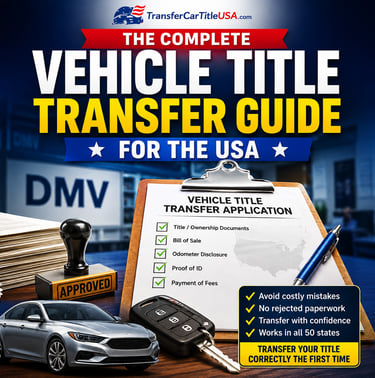
👉 If you want to transfer your car title the right way, the first time, the full eBook gives you everything you need—without confusion, delays, or costly mistakes.
https://transfercartitleusa.com/the-complete-guide
📑 DMV Title Transfer Guide: Avoid Rejection
Comprehensive Guide to Document Verification, Regulatory Compliance, and State-Specific Procedures
Navigating DMV paperwork can be tricky, and even small mistakes can lead to immediate rejection. Our comprehensive guide covers essential DMV title transfer documents and common oversights. Don’t face penalties or confusion at the counter—read now to ensure a smooth process and succeed on your first attempt.
🛠️ Section 1: Introduction to the Vehicle Title Ecosystem
The Legal Significance of a Certificate of Title
A Certificate of Title (commonly referred to as a "pink slip" in states like California, or simply a car title) is a state-issued legal security document that establishes definitive proof of ownership for a motor vehicle, vessel, or mobile home. It is not merely a administrative receipt; it is an instrument of property law monitored by state departments of motor vehicles under strict statutory frameworks.
Because a title represents a high-value asset, state governments manufacture these documents using specialized security measures similar to currency. These include intaglio printing, microscopic watermarks, specialized security threads, and chemically sensitive paper designed to reveal immediate discoloration if mechanical or chemical alterations are attempted.
When a vehicle changes hands through a private sale, inheritance, gift, or auction, the legal ownership structure must be altered within the state’s centralized registry. This process is known as a Title Transfer. Until the Department of Motor Vehicles (DMV) or equivalent state agency processes this transfer and issues a new certificate, the transaction is incomplete in the eyes of the law, leaving both buyer and seller exposed to significant civil, financial, and criminal liabilities.
The Financial and Legal Consequences of DMV Rejection
A failed title transfer at the DMV counter is more than an inconvenience; it can result in immediate, severe administrative bottlenecks and financial exposure:
Escalating Statutory Late Fees: Most states impose strict statutory windows (typically 10 to 30 calendar days) from the date of sale to complete a title transfer. If your paperwork is rejected on day 29 and you cannot secure an appointment to return until day 35, you will face automatic, non-waivable late transfer penalties that escalate every 30 days.
Vehicle Registration Delinquency: A title transfer is almost always tied to vehicle registration. If the registration expires while your title paperwork is locked in a rejection cycle, the vehicle cannot legally be driven on public roadways. This exposes the buyer to citations, law enforcement stops, and vehicle impoundment.
Prolonged Civil Liability for the Seller: If the buyer’s title application is rejected and they fail to rectify it, the seller remains the owner of record in the state computer system. If the buyer accumulates toll violations, parking tickets, or causes a catastrophic traffic accident, law enforcement and insurance collection agencies will target the seller.
The "Cold Case" Transaction Trap: If a title is rejected weeks after the sale because of a missing signature or an unreadable name, the buyer must track down the seller. If the seller has changed their phone number, moved out of state, or refuses to cooperate, the buyer is left with a vehicle that cannot be titled, registered, or legally sold—rendering it a total financial loss.
🧭 Section 2: Executive Summary: The Universal 4-Step Title Transfer Framework
To consistently navigate the bureaucratic process without encountering a counter rejection, you must look past the superficial differences between various state offices and realize that every vehicle title transfer in the United States follows a standardized four-phase lifecycle.
[Phase 1: Legal Release] ➔ (Seller Signs)
[Phase 2: Financial Documentation] ➔ (Bill of Sale & Tax Form)
[Phase 3: State Verification] ➔ (VIN/Smog Inspection)
[Phase 4: Registration & Issuance] ➔ (New Title Printed)
By dividing your preparation into these distinct chronological quadrants, you can run quality-assurance checks on your paperwork before presenting it to a DMV clerk.
Phase 1: Legal Release (Seller Obligations)
The transfer lifecycle begins exclusively with the current registered owner of record. In this phase, the seller must physically sign the vehicle title certificate to relinquish their legal ownership rights. This step requires verifying the exact layout of the state's title certificate, confirming whether a notary public must witness the signature, clearing any outstanding financial liens with an authorized bank stamp, and recording an unrounded, completely accurate odometer reading.
Phase 2: Financial Documentation (Joint Execution)
Once ownership is released, the transaction must be framed in financial and fiscal terms for the state’s department of revenue or taxation. The buyer and seller must jointly execute a formal Bill of Sale and fill out state-specific tax declaration forms. This phase ensures that the state can accurately calculate and collect automotive sales tax, verify that the purchase price reflects fair market value, and confirm that no illegal tax underreporting is taking place.
Phase 3: State Verification (Buyer Compliance)
With the signed title and financial disclosures in hand, the buyer assumes full operational control of the paperwork. Before the state will accept the application, the vehicle must be proven compliant with local environmental, public safety, and anti-theft statutes. This phase involves taking the physical vehicle to authorized regional facilities for specialized testing, which may include emissions testing (smog checks), safety equipment inspections, or physical Vehicle Identification Number (VIN) verifications to rule out auto theft or title cloning.
Phase 4: Registration & Issuance (DMV Processing)
The final phase occurs directly at the DMV office or through an authorized digital service portal. The buyer presents the compiled document package, verifies their identity with a government-issued photo ID, provides proof of active auto insurance, and pays all state titling fees, registration renewals, and localized sales taxes. The DMV clerk reviews the package against the state database, clears the old registration record, logs the new owner, and initiates the printing process for a clean, secure Certificate of Title.
🏛️ Section 3: Anatomy of a Vehicle Title Certificate
A primary catalyst for DMV counter rejection is a basic misunderstanding of the fields, boxes, and legal terminology printed directly onto a title certificate. Making an incorrect ink mark on a secure title document instantly voids its validity. It is critical to study the four universal quadrants of a title before allowing a pen to touch the paper.
Quadrant 1: The Primary Header (Ownership Block)
Located at the top of the document, this section displays the official legal names and physical addresses of the individuals or entities who currently hold lawful title to the vehicle. Pay close attention to how these names are listed, as this exact spelling must be used on all subsequent application forms.
Quadrant 2: The Vehicle Identification Profile
This section contains the permanent physical parameters of the vehicle. It outlines the make, model, year, body style, empty weight, fuel type, and—most importantly—the 17-digit Vehicle Identification Number (VIN). The VIN serves as the vehicle's unique fingerprint, tracking it across manufacturing plants, insurance claims, accidents, and state borders.
Quadrant 3: The Lienholder/Legal Owner Section
If the vehicle was financed through a bank, credit union, or private dealership group, that institution will be prominently listed here as the legal owner or primary lienholder. A title with a named lienholder cannot be transferred under any circumstances until this quadrant features an official, dated signature from an authorized banking representative or is accompanied by a standalone, notarized lien release document.
Quadrant 4: The Assignment of Title (Transfer Block)
This section is located either on the lower portion of the front face or across the reverse side of the document. This is where the transaction physically occurs. It contains dedicated boxes for the seller’s signature, the buyer’s printed name and address, the exact transaction date, the purchase price, and the mandatory odometer disclosure block.
Grammatical Conjunctions and Their Legal Impact
When multiple owners are listed in Quadrant 1, you must look closely at the exact grammatical conjunction connecting their names. This tiny linguistic detail alters your legal signature requirements at the DMV counter:
Conjunction Between NamesLegal DefinitionSignatory Obligation for Transfer"OR"Joint tenancy with right of survivorship.Only one of the listed owners needs to sign the title to legally release the vehicle."AND"Tenancy in common.Both listed owners must physically sign the title. Missing one signature results in immediate rejection."AND/OR"Ambiguous joint tenancy (State-dependent).Varies by jurisdiction. Some states allow one signature, while others require both. Best practice is to get both signatures to ensure smooth processing.
🗺️ Section 4: State-Specific Jurisdictions: Rules, Fees, and Timelines
The United States does not have a federal DMV; vehicle registration and titling are governed entirely at the state level. Consequently, the operational protocols, processing timelines, and fee schedules vary substantially across different regions. Let's look closely at the specific rules for four of the largest automotive markets in the country.
☀️ California DMV (Department of Motor Vehicles)
California runs a highly regulated, consumer-protective titling system that requires a thorough stack of supporting documentation.
Primary Master Form: Form REG 343 (Application for Title or Registration). This form must be filled out completely by the buyer whenever an out-of-state vehicle is brought into California or when a title is being updated.
Lost Title Protocol: If the original title has been lost, stolen, or mutilated, California bypasses the standard process by requiring Form REG 227 (Application for Duplicate or Paperless Title), which must be signed by the seller and notarized if the vehicle value exceeds specific thresholds.
The 90-Day Smog Rule: California requires a valid smog compliance certificate for most gasoline-powered vehicles during a title transfer if the vehicle is more than 8 model-years old. The legal statutory responsibility to provide this smog check lies with the seller, and the certification must be dated within 90 days of the transfer date.
Seller Protection Mandate: The seller must submit a Notice of Transfer and Release of Liability (Form REG 138) online or by mail within 5 calendar days of the sale. This formally alerts Sacramento to pause the seller's liability for parking tickets, toll fees, and traffic infractions.
🤠 Texas DMV (TxDMV)
Texas prioritizes rapid processing but enforces strict anti-fraud measures regarding sales tax valuation and transaction timelines.
Primary Master Form: Form 130-U (Application for Texas Title and/or Registration). This form is mandatory for every transfer and must outline the exact odometer reading and sales price.
The 30-Day Strict Window: Texas grants buyers exactly 30 calendar days from the date of sale to file their title transfer. If this window closes, the buyer faces a financial penalty starting at $25 and increasing by $25 for every month delayed. Eligible military personnel receive an extended 60-day window.
Standard Presumptive Value (SPV) Tax System: To prevent buyers and sellers from colluding to underreport purchase prices on Form 130-U, Texas calculates sales tax based on the vehicle’s Standard Presumptive Value (SPV) derived from private market data. If your reported purchase price is below 80% of the SPV, your 6.25% sales tax will be calculated using the higher SPV figure unless you provide a certified private appraisal form.
Seller Protection Mandate: Sellers should submit a Texas Motor Vehicle Transfer Notification (Form VTR-346) within 30 days to ensure they are fully protected against toll charges or criminal activities involving the car.
🐊 Florida DHSMV (Department of Highway Safety and Motor Vehicles)
Florida utilizes a decentralized administrative model where county tax collectors process title transfers directly, offering uniquely fast turnarounds.
Primary Master Form: Form HSMV 82040 (Application for Certificate of Title). This multi-purpose document handles initial titling, registration, and VIN disclosures simultaneously.
Out-of-State VIN Verification Protocol: If a vehicle is being imported into Florida from another state, it cannot be titled until its VIN is physically verified. This requires Form HSMV 82042, which must be completed after a physical inspection by a licensed Florida notary public, a law enforcement officer, a car dealer, or a DMV compliance examiner.
Fast Title Counter Service: Florida stands out because its County Tax Collector offices offer an optional Instant Title over-the-counter service for an additional fee (typically $10). This prints your new physical title right at the desk in minutes, avoiding the usual multi-week mailing delay.
Seller Protection Mandate: The seller must complete Form HSMV 82050 (Notice of Sale) and file it with their local tax collector within 30 days to remove their liability record from the state computer system.
🍎 New York DMV (Department of Motor Vehicles)
New York enforces strict fiscal and insurance matching rules before any title can be successfully processed.
Primary Master Form: Form MV-82 (Vehicle Registration/Title Application) combined with Form DTF-802 (Statement of Transaction for Sales Tax).
Electronic Insurance Matching System: New York requires a continuous, real-time link between auto insurance carriers and the DMV database. The buyer must secure New York State personal auto liability insurance before attempting the transfer. The insurance company must issue an electronic New York State Insurance Identification Card (Form FS-20) that matches the VIN on the title exactly.
Sales Tax Audit Enforcement: The New York Department of Taxation and Finance closely reviews Form DTF-802. If a vehicle is sold well below fair market value, Section 6 of the form must be completed by the seller explaining the low price (e.g., severe mechanical defects or a gift between family members), or the transaction will be flagged for an audit.
Seller Protection Mandate: New York does not have a formal online release form; instead, the seller must keep a signed Bill of Sale (Form MV-912) or a copy of the signed title as their personal receipt to prove ownership has shifted.
🛠️ Section 5: The Comprehensive Step-by-Step Title Transfer Playbook
Phase 1: The Transaction (Seller Actions)
[Locate Title Document] ➔ [Verify Security Condition] ➔ [Acquire Lien Release] ➔ [Log Odometer Reading] ➔ [Execute Signature]
Step 1: Document Location and Authentication
Locate your original Certificate of Title. Check the issue date to ensure it is the most recent title printed by the state (applying for a duplicate title automatically invalidates all previous versions). Look closely at the paper for any tears, stains, or water damage that could mask the security elements or text.
Step 2: Financial Lien Liquidation
Look at the front of your title to see if a bank or credit union is listed as a lienholder. If a lien is present, you cannot sell the car until it is legally cleared. You must either have the bank sign off directly in the title's release box or obtain an official, standalone Lien Release Letter on the bank's letterhead. This letter must include an authorized signature, a clear bank stamp, and detail the year, make, model, and VIN of your vehicle.
Step 3: Precise Odometer Disclosure
Walk out to your vehicle, turn the key, and read the exact current mileage on the digital or analog dashboard display. Write this number down precisely as it appears. Do not round up to the nearest hundred, do not round down, and do not guess. Enter these digits carefully into the dedicated odometer assignment box on your title certificate.
Step 4: Execution of Signature
Locate the specific line marked "Signature of Registered Owner" or "Seller's Signature". Sign your legal name precisely as it is printed on the front of the title. If your middle initial is included on the front, include it in your signature.
Step 5: Transfer and Release of Liability Submission
Within 24 to 72 hours of delivering the vehicle to the buyer, log onto your state's online DMV portal and complete the digital Release of Liability form (such as California’s REG 138 or Texas's VTR-346). Enter the buyer’s full name, address, phone number, the final sale price, and the exact date the keys were handed over. This step officially updates the state database and protects you from any liability moving forward.
Phase 2: The Acquisition (Buyer Actions)
[Match 17-Digit VIN] ➔ [Validate Seller ID] ➔ [Execute Buyer Block] ➔ [Complete Bill of Sale] ➔ [Secure State Inspections]
Step 1: VIN Matching and Identity Verification
Pop the hood of the vehicle and look at the metallic plaque riveted into the driver’s side dashboard where it meets the windshield. Compare this 17-digit VIN character-by-character with the VIN printed on the seller's title certificate, your insurance card, and the bill of sale. A single mismatch error will cause an immediate rejection at the DMV counter. Next, ask to see the seller’s driver’s license and confirm that their photo and full name match the registered owner listed on the title.
Step 2: Execution of the Buyer Block
Locate the buyer's section on the title certificate (often titled "Assignment of Title by Registered Owner"). Print your full legal name, physical living address, city, state, and zip code. Sign your name on the line marked "Signature of Buyer".
Step 3: Complete the Bill of Sale
Fill out a comprehensive, state-approved Bill of Sale. Both buyer and seller must fill out and sign this document. Ensure it explicitly states the complete vehicle description (Year, Make, Model, VIN), the exact date of purchase, the final agreed-upon sales price, and an explicit statement confirming that the vehicle is being transferred free and clear of all encumbrances.
Step 4: Secure State Compliance Inspections
If your state requires physical safety inspections, emissions checking, or VIN verifications for out-of-state cars, drive the vehicle to an authorized state inspection facility before going to the DMV. Keep all printed compliance certificates, physical inspection sheets, and receipts to include in your final document package.
Step 5: Final Submission to the DMV Counter
Compile your document package: the signed original title, the completed Bill of Sale, state tax forms, your compliance inspection certificates, your physical driver’s license, and your proof of active auto insurance. Bring this complete package to your local DMV office or log into your state's online processing portal. Pay all title fees, registration adjustments, and local sales taxes to complete the transfer and receive your new title.
⚙️ Section 6: The Universal Process Blueprint
To keep track of who is responsible for each document and action, use this centralized guide during your transfer process:
⚠️ Section 7: Critical Pitfalls & Mitigation Strategies
Avoid these five high-friction errors that routinely lead to document rejections at the DMV counter:
Pitfall 1: The White-Out and Erasure Disaster
The Problem: A user accidentally spells a name wrong or writes a number incorrectly in the assignment block and uses white-out, correction tape, or crosses out the text with a pen.
The Counter Outcome: Immediate Rejection. DMV computer systems and clerks view any physical erasure or cross-out as a potential sign of fraudulent title modification, instantly voiding the document.
Mitigation Strategy: If an error occurs, do not use correction tape or cross out the text. Leave the mistake exactly as it is written. Download and print a formal state-approved Statement of Facts or Affidavit of Correction form. Both parties must fill out this form to state under penalty of perjury that the initial marking was a clerical error and outline the correct information.
Pitfall 2: The Odometer Discrepancy Lockout
The Problem: A seller guesses the vehicle's mileage or writes it down incorrectly, resulting in a number lower than what was logged during a previous registration renewal or smog check.
The Counter Outcome: Fraud Alert / Rejection. The DMV computer database will flag the application for an odometer rollback mismatch, blocking the title transfer and launching an administrative review.
Mitigation Strategy: Always verify the dashboard display right before writing down the mileage. If a mistake is made on the title, you must submit a specialized Odometer Correction Affidavit signed by both the buyer and seller, along with corroborating maintenance logs, dealer service receipts, or smog check printouts.
Pitfall 3: The "Skipped Title" Trap (Wholesale Curbstoning)
The Problem: A buyer purchases a car from a private seller whose name is not listed on the front of the title certificate. The seller claims they bought the car from someone else but never registered it in their own name to avoid paying sales tax.
The Counter Outcome: Absolute Rejection. This practice is illegal and known as "title skipping" or "curbstoning." The DMV will refuse to process the document because the chain of legal ownership has been broken.
Mitigation Strategy: Never purchase a vehicle from a seller whose name does not match the front of the title or an attached dealer reassignment document. Demand that the seller formally title the car in their own name and pay their sales tax first before you hand over any money.
Pitfall 4: Unreleased Financial Bank Liens
The Problem: A buyer purchases a vehicle assuming a loan is fully paid off, but the front of the title certificate still lists a financial institution as a lienholder.
The Counter Outcome: Transaction Hold. The state views the bank as the legal owner of the vehicle, meaning it cannot be legally sold or transferred by the registered owner alone.
Mitigation Strategy: Before completing the purchase, check the lienholder block on the title. If it is occupied, ensure the bank has signed and stamped the built-in release box. If they haven't, secure an original, notarized Lien Release Letter from that financial institution containing the bank's contact details, authorized signatures, and complete vehicle attributes.
Pitfall 5: Incomplete Signatures on Dual-Owner Titles
The Problem: A vehicle is owned by a married couple or business partners, but only one individual signs the title block to release ownership.
The Counter Outcome: Immediate Rejection. If the title features the word "AND" between the co-owners' names, the state considers them tenants-in-common, requiring both signatures to clear the title.
Mitigation Strategy: Review the names printed on the front of the certificate. If they are joined by the conjunction "AND", you must have both owners physically present to sign the document before heading to the DMV counter.
📋 Section 8: Specialized Scenarios & Complex Title Transfers
While direct private vehicle sales are the most common type of transfer, several alternative ownership scenarios require specialized documentation and distinct legal frameworks.
🏛️ Scenario A: Inherited Vehicles and Estate Administration
When a vehicle owner passes away, their car becomes part of their legal estate. Transferring the title of an inherited vehicle requires navigating probate law alongside standard DMV regulations. The exact protocol depends heavily on the total financial valuation of the deceased individual’s estate.
Formal Probate Administration Process
If the estate undergoes formal probate court proceedings, the court will appoint a legal representative known as an Executor (if a valid will exists) or an Administrator (if the individual died intestate). To transfer the vehicle title, this representative must provide:
The Original Certificate of Title: Signed in the seller assignment section by the designated Executor or Administrator (e.g., written as "Estate of John Doe, by Jane Doe, Executor").
Certified Letters Testamentary or Letters of Administration: This official court document serves as absolute proof that the court has authorized the executor to manage and distribute the estate's physical assets. Copies are rejected; the document must feature a raised seal from the probate court.
Certified Copy of the Death Certificate: Required by the DMV to confirm the owner of record has passed away.
Small Estate / Affidavit of Succession Process
If the deceased individual's total estate value falls below your state’s specific probate threshold, you can often bypass formal court administration using a simplified process. Most states provide an Affidavit for Transfer of Vehicle Without Probate form (such as California’s Form REG 5 or Texas’s Form VTR-262).
[Gather Death Certificate] ➔ [Complete Small Estate Affidavit] ➔ [Obtain Signatures of All Heirs] ➔ [Submit to DMV Counter]
To complete this transfer, the primary legal heir must fill out the affidavit, swear under penalty of perjury that the estate layout qualifies for the exemption, secure concurrent signatures from all other immediate living heirs releasing their interest, and present the form along with a certified copy of the death certificate directly to the DMV counter.
🏛️ Scenario B: Out-of-State Title Transfers (State Relocation)
When an individual permanently moves across state lines, they must register their vehicle and secure a new title from their new home state within a strict statutory window—typically 30 to 90 days from the date residency is established.
Step-by-Step State Relocation Protocol
Secure the Physical Out-of-State Title Certificate: If you own the vehicle outright, you must bring the physical title certificate with you to your new local DMV office.
Handle Active Vehicle Financing (Lienholder Intercept): If you are currently financing the vehicle, your bank holds the physical title out of state. You cannot complete the transfer alone. You must go to your new state’s DMV website and download a formal Title Transfer Request Form. You mail this form to your lender, authorizing them to release the physical title certificate directly to your new state's DMV headquarters via secure mail. Once the DMV receives it, they will notify you to come into a local office to complete your registration.
Undergo a Mandatory Physical VIN Inspection: Most states require all out-of-state vehicles to undergo a physical VIN verification to prevent auto theft and title fraud. A DMV official or law enforcement officer must inspect the vehicle to verify that the VIN plaque on the dashboard matches your registration paperwork exactly.
Establish Local Financial Responsibility: Your out-of-state auto insurance policy is not valid for local titling. You must contact an insurance agent licensed in your new state to issue a local policy that meets the state's minimum coverage limits before visiting the DMV.
🏛️ Scenario C: Vehicle Gifts and Family Transfers
Transferring a vehicle as a gift or selling it to an immediate family member (spouse, parent, sibling, or child) follows the same basic signature process as a standard private sale, but features significant tax advantages.
Navigating Sales Tax Exemptions
Most state departments of revenue allow immediate family members to transfer vehicles without paying standard automotive sales tax. However, you cannot simply write "$0" on the title and walk away. To secure this exemption, you must submit a state-specific family affidavit form alongside the title application (such as California’s Form REG 256 or Texas’s Form 14-317).
FAMILY RELATIONSHIP VALUE CHECK
| Standard Private Sale: ---------------> Subject to State Sales Tax
| Immediate Family Gift Affidavit: ------> 100% Tax Exempt
This document requires both parties to state their exact family relationship under penalty of perjury and confirm that no monetary exchange took place. If the vehicle is a gift to a non-family member, a standard Gift Affidavit must be filled out, though the recipient may still be liable for state use tax based on the vehicle’s fair market value.
❓ Frequently Asked Questions (FAQ)
1. Can you complete a vehicle title transfer online or via digital options?
Yes, many states have introduced digital portals to reduce wait times at physical offices. For example, California offers the Virtual DMV Assistant for document uploads, Texas supports eTitle updates through authorized regional systems, and New York runs an Express Title service.
However, digital options have limitations. If your transfer involves an out-of-state title, a deceased owner's estate, an unreleased lien from a defunct bank, or requires a physical VIN inspection, you must complete the transaction in person at a physical DMV office or via secure mail.
2. What should I do if the original vehicle title is lost, stolen, or destroyed?
If the title is missing, the current owner of record must apply for a duplicate title before any transfer can occur. A buyer cannot apply for a duplicate title on a vehicle they just bought because their name is not yet logged in the state database.
The seller must complete a state-specific application for a duplicate title (such as CA Form REG 227 or TX Form VTR-34), pay the duplicate title fee, and secure the new document. Some states allow the seller to combine the duplicate title application and the transfer process into a single transaction if both parties visit the DMV counter together.
3. How do I clear a lien if the financing bank has gone out of business?
If your vehicle loan was paid off years ago but the bank went out of business without signing a formal lien release, you face a significant bureaucratic challenge. You must contact the Federal Deposit Insurance Corporation (FDIC) to determine which banking institution acquired the defunct bank’s remaining assets.
The FDIC can often provide a formal letter certifying the acquisition, or you can work with the successor bank to secure a clean lien release. If no successor bank can be found, you will need to purchase a Defective Title Bond through an insurance surety company to protect the state against future financial claims before a new title can be issued.
4. What is a bonded title, and when is it necessary to get one?
A Bonded Title is a specialized certificate of title marked with a security bond brand. It is used when a buyer purchases a vehicle without receiving a title certificate and cannot contact the previous owner to get a duplicate.
To secure one, the buyer must purchase a surety bond equal to 1.5 to 2 times the fair market value of the vehicle. This bond is filed with the DMV and acts as a financial insurance policy. If a legitimate owner surfaces later claiming they own the vehicle, the bond funds are used to clear their claim. After a statutory holding period (typically 3 years), the bonded brand is dropped, and the buyer receives a clean, standard title.
5. Can a minor legally own and transfer a vehicle title?
While a minor can legally own a vehicle, most states enforce strict rules regarding vehicle registration and liability for individuals under 18 years old.
Many jurisdictions require a parent or legal guardian to co-sign the title application forms and assume joint financial responsibility for the vehicle's auto insurance policy. When a minor sells a car, some states require a parent's signature alongside the minor's to validate the transaction and protect the buyer from contract cancellation laws.
6. What happens if I move out of state while my title application is processing?
If you relocate while your title application is processing, your paperwork will experience significant delays. Standard titles are sent via non-forwardable mail to prevent identity theft, meaning the U.S. Postal Service will return the document to the DMV headquarters if you no longer live at that address.
To fix this, contact the processing DMV immediately to update your mailing address to your new out-of-state location, or update your delivery address using an authorized online portal before the title enters the final printing queue.
🛑 Comprehensive Pre-DMV Checklist
Before leaving for your local DMV office, verify that you have completed every check on this final quality-assurance list:
Ink Color Verification: Every signature and form entry is written using permanent blue or black ink. Pencil markings or colored inks are completely absent.
Physical Condition Check: The original title certificate is free from physical rips, tears, water stains, or unreadable blocks.
No Manual Erasures: The title is free from white-out, correction tape, crossed-out text, or erasures.
Odometer Match: The mileage entered in the disclosure box matches your physical vehicle dashboard exactly, without rounding or guessing.
Conjunction Signatures: Titles listing multiple owners joined by "AND" feature signatures from both individuals in the release block.
Lien Verification: The lienholder block is empty, features an official bank stamp, or is accompanied by an original Lien Release Letter.
VIN Character Check: The 17-digit VIN matches character-for-character across your title, bill of sale, and auto insurance card.
Active Local Insurance: You have an active auto insurance policy that complies with your state's minimum coverage limits.
Compliance Certifications: You have all required regional compliance documents, including fresh smog check printouts, safety sheets, and physical inspection receipts.
If you want a state-aware checklist, scenario-specific guidance, and a DMV-proof document list tailored to every situation—private sale, lien, gift, inheritance, or out-of-state—the complete eBook walks you through it step by step.
👉 Before you go to the DMV, make sure you have every document the clerk expects—nothing missing, nothing guessed.https://transfercartitleusa.com/the-complete-guide


Help
Quick tips to avoid DMV delays
Contact
infoebookusa@aol.com
© 2026. All rights reserved.