Final Conclusion: Transfer Your Car Title the Right Way—Once

Blog post description.

1/23/202614 min read

Final Conclusion: Transfer Your Car Title the Right Way—Once

If there is one moment in the entire vehicle ownership lifecycle where mistakes are the most expensive, stressful, and time-consuming, it is the car title transfer. Not buying the car. Not selling it. Not even insuring it.
The title transfer.

This is the legal heartbeat of vehicle ownership. Get it right, and everything else flows smoothly. Get it wrong—even slightly—and you may spend months fixing paperwork, hundreds or thousands of dollars, and countless hours dealing with DMVs, lienholders, buyers, sellers, and insurance companies who all point fingers at each other.

This conclusion exists for one purpose: to make sure you never have to do this twice.

Because here is the truth most people only learn the hard way:

A car title transfer is not forgiving.
There is no “close enough.”
There is no “we’ll fix it later.”

There is only right the first time or painful cleanup afterward.

Why Most People Fail at Car Title Transfers

Most title transfer disasters don’t happen because people are careless. They happen because people assume.

They assume:

  • The seller filled out their section correctly

  • The buyer can just “sign later”

  • The lien is “probably cleared”

  • The odometer reading “isn’t a big deal”

  • The DMV will “tell them if something is wrong”

Every one of those assumptions has destroyed otherwise clean transactions.

A single missing signature.
A date written in the wrong format.
An abbreviation where a full legal name was required.
An odometer box checked incorrectly.

These are not small errors. In the DMV system, they are fatal errors.

The Emotional Cost No One Talks About

What people rarely talk about is the emotional weight of a failed title transfer.

You feel:

  • Anxiety every time a letter arrives from the DMV

  • Fear that you’ll be fined, audited, or accused of fraud

  • Anger at yourself for “not knowing”

  • Helplessness when customer service gives conflicting answers

  • Stress when the buyer or seller starts threatening legal action

And the worst part?

You’re usually stuck in the middle—unable to drive, sell, insure, or register the vehicle until it’s resolved.

For many people, this isn’t just a car.
It’s their commute.
Their family transportation.
Their livelihood.

A broken title transfer can disrupt your entire life.

The System Is Not Designed to Help You

Let’s be brutally honest.

DMV systems were not designed for clarity.
They were not designed for edge cases.
They were not designed to protect you from mistakes.

They are designed to reject incorrect paperwork.

When something is wrong, the system does not guide you gently toward a solution. It simply stops. Files are flagged. Applications are denied. Letters are sent weeks later with vague explanations. Phone lines are overloaded. Offices require appointments booked months out.

And every delay compounds the problem:

  • Late fees accumulate

  • Temporary registrations expire

  • Insurance coverage becomes complicated

  • Buyers lose patience

  • Sellers disappear

This is how simple errors spiral into legal nightmares.

The Difference Between “Transferring a Title” and Transferring It Correctly

Anyone can submit paperwork.

Very few people understand how to structure a title transfer so it survives scrutiny.

Transferring a title correctly means:

  • Every field completed exactly as required by law

  • Every signature placed in the correct location

  • Every supporting document aligned and consistent

  • Every timeline respected

  • Every edge case anticipated

It means thinking like:

  • A DMV examiner

  • A lien verification officer

  • A fraud prevention system

  • A future buyer

  • An insurance underwriter

This is not common sense.
This is procedural literacy.

Why Doing It “Later” Is a Trap

One of the most dangerous phrases in any car transaction is:

“We’ll fix that later.”

Later rarely comes.

Later becomes:

  • The seller moved

  • The buyer stopped responding

  • The lienholder changed names

  • The DMV updated a form

  • The state changed regulations

  • The deadline passed

What could have been solved in 10 minutes at the time of sale becomes a multi-month recovery process involving affidavits, bonded titles, notarized statements, and sometimes court involvement.

The best title transfer is the one that never needs correction.

The High-Stakes Situations Where Mistakes Hurt the Most

Some title transfers are forgiving. Others are not.

Mistakes are especially catastrophic when:

  • The vehicle is financed or recently paid off

  • The seller is deceased or unavailable

  • The title is from another state

  • The vehicle was gifted or inherited

  • The VIN has discrepancies

  • The vehicle was previously salvaged or rebuilt

  • The buyer is registering in a strict state

  • The sale involves family or friends

These are exactly the scenarios where people rely on assumptions—and where the system shows zero mercy.

You Only Get One Clean Chance

Here is the reality no one spells out:

Your first submission is the most powerful one.

Once a title transfer is rejected:

  • Your file is flagged

  • Your transaction history becomes complicated

  • You may be forced into alternative processes

  • The burden of proof shifts onto you

From that moment on, you are no longer transferring a title.
You are fixing a problem.

And fixing problems is always harder than doing it right once.

This Is Why Experts Don’t “Wing It”

Professionals—dealers, title clerks, auto attorneys—do not rely on memory or guesswork.

They use:

  • Checklists

  • Verified examples

  • State-specific rules

  • Contingency planning

  • Pre-submission validation

They know that confidence is not accuracy.

And they know that the cost of being wrong far exceeds the cost of being prepared.

The Smart Path Forward

If you’ve read this far, you already understand something critical:

You don’t want to hope your title transfer is correct.
You want to know it is.

You want:

  • Zero rejections

  • Zero follow-up letters

  • Zero surprises

  • Zero second trips

  • Zero stress

You want to walk away knowing:

“This is done. For good.”

The Strongest Advice You’ll Ever Get on Car Title Transfers

Do not rely on:

  • Outdated blog posts

  • Conflicting forum advice

  • DMV clerks having a “good day”

  • Memory

  • Assumptions

Rely on clear, step-by-step, state-aware guidance that shows you:

  • Exactly what to fill out

  • Exactly how to fill it out

  • Exactly what to check before submission

  • Exactly how to avoid irreversible errors

Because the goal is not to submit paperwork.

The goal is to never have to think about this again.

Your Next Step (And the One That Saves You from Regret)

If you want absolute confidence—if you want to transfer your car title the right way, once, without mistakes, delays, or stress—there is one clear path forward.

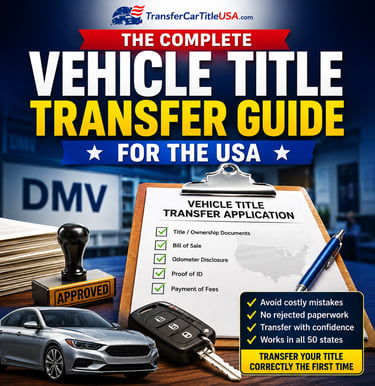
Get The Complete Guide.

It doesn’t summarize.
It doesn’t guess.
It doesn’t skip edge cases.

It walks you through every scenario, every form, every signature, and every decision so you can complete your title transfer correctly the first time—no matter your state, your situation, or your vehicle’s history.

Because peace of mind isn’t optional when it comes to ownership.

It’s essential.

And once you understand the process at this level, you’ll never fear a title transfer again.

This is not the end of the topic.
It’s the point where people who want certainty take the next step.

Get The Complete Guide.

continue

because certainty is not something you improvise—it’s something you build deliberately.

And that is the final truth that separates people who struggle with car title transfers from those who never think about them again.

They don’t get lucky.
They don’t “hope the DMV approves it.”
They don’t rely on verbal assurances or half-remembered instructions.

They engineer certainty.

Why This Conclusion Matters More Than the Beginning

Most articles start strong and end weak.
This one ends strong because the end is where mistakes happen.

At the beginning of a title transfer, everyone is motivated.
Everyone is cooperative.
Everyone is present.

At the end:

  • Someone is in a hurry

  • Someone is tired

  • Someone says “that should be fine”

  • Someone skips a step

  • Someone signs in the wrong place

  • Someone forgets to double-check

And that is exactly when the damage is done.

The end of the process is not a formality.
It is the point of no return.

The Hidden Cost of “Almost Right”

There is no such thing as “almost correct” in title transfers.

An “almost right” title:

  • Can’t be registered

  • Can’t be insured properly

  • Can’t be sold cleanly

  • Can’t be used as collateral

  • Can’t be trusted by future buyers

It becomes a liability disguised as ownership.

And the worst part?

You may not discover the problem until months or years later, when:

  • You try to sell the car

  • You move to another state

  • You refinance

  • You’re involved in an accident

  • The vehicle is totaled

  • The original seller can no longer be found

That’s when a tiny oversight turns into a massive problem—with no easy way out.

Why “I’ll Just Ask the DMV” Is Not a Strategy

One of the most common mistakes people make is assuming the DMV will guide them step by step.

They won’t.

DMV employees:

  • Do not review your entire transaction

  • Do not analyze future consequences

  • Do not warn you about edge cases

  • Do not check for consistency across documents

  • Do not correct errors proactively

They process what you submit.

If it’s wrong, they reject it.
If it’s incomplete, they return it.
If it’s ambiguous, they flag it.

They are not advisors.
They are gatekeepers.

The Real Goal: A Title That Never Gets Questioned

The gold standard of a title transfer is not approval.

It’s silence.

No letters.
No requests.
No clarifications.
No future complications.

A clean title transfer disappears into the system—and stays there.

That only happens when:

  • Every entry matches across documents

  • Every legal requirement is satisfied

  • Every exception is handled before submission

  • Every assumption is eliminated

That level of precision does not happen by accident.

Why Smart People Still Get This Wrong

Intelligence does not protect you from bureaucratic complexity.

Doctors, engineers, lawyers, and business owners all make title transfer mistakes—not because they’re careless, but because this system operates on rules they don’t encounter elsewhere.

It’s not logical.
It’s procedural.
It’s rigid.
It’s unforgiving.

And that’s exactly why confidence is dangerous here.

The Difference Between Stress and Control

There are two emotional states during a title transfer:

  1. Stress

    • “Did we fill that out correctly?”

    • “What if they reject it?”

    • “What happens if this is wrong?”

    • “Why is this taking so long?”

  2. Control

    • “I’ve verified every step.”

    • “I know this meets state requirements.”

    • “There’s nothing left to guess.”

    • “This is done.”

Control comes from preparation—not optimism.

This Is the Last Time You Should Ever Worry About This

A car title transfer should not be a recurring source of anxiety.

Once you understand:

  • How titles actually work

  • Where people really make mistakes

  • What the DMV actually checks

  • How to preempt rejection

  • How to handle special cases correctly

You don’t just solve this problem once.

You eliminate it forever.

Every future purchase.
Every sale.
Every transfer.
Every state.

Handled cleanly.
Handled confidently.
Handled once.

The Final Word (And the One That Matters)

There are two types of people who transfer car titles:

Those who hope it goes through.
And those who know it will.

Hope is expensive.
Knowledge is permanent.

If you want to do this the right way—the only way that actually protects you—don’t leave it to chance.

Get The Complete Guide.

Not because you want more information.
But because you want zero uncertainty.

This is how you transfer your car title the right way—once.

And never think about it again.

continue

because “never thinking about it again” is the real victory.

Not relief.
Not approval.
Not a stamped form.

Freedom from the issue entirely.

The Moment People Realize They Underestimated This

Ask anyone who has ever had a title transfer go wrong and they will tell you the same thing:

“I didn’t think it was that serious.”

They thought:

  • It was just paperwork

  • It was routine

  • It was administrative

  • It was reversible

Until it wasn’t.

Until the DMV rejected it.
Until the buyer demanded a refund.
Until insurance refused coverage.
Until a lien resurfaced.
Until penalties appeared.
Until time ran out.

That realization always comes after the damage is done.

This article exists so that moment never happens to you.

The System Rewards Precision, Not Effort

You can try hard and still fail.

You can be honest and still be rejected.

You can mean well and still violate a rule you didn’t know existed.

The system does not care about intent.
It cares about compliance.

And compliance requires:

  • Exact formatting

  • Exact timing

  • Exact documentation

  • Exact sequencing

This is why “almost right” is still wrong.

One Signature Can Change Everything

People underestimate how much power lives in small boxes and tiny lines.

One signature:

  • In the wrong place

  • With the wrong date

  • With a nickname instead of a legal name

  • Before or after the wrong step

Can void an entire transfer.

And once that happens, the fix is never as simple as “sign again.”

Because now:

  • The chain of custody is broken

  • The record is inconsistent

  • The timeline is questioned

  • The system loses trust

From that point forward, you are proving instead of submitting.

Time Is the Invisible Enemy

Title transfers are time-sensitive whether people realize it or not.

Deadlines exist:

  • For submission

  • For registration

  • For penalties

  • For tax implications

  • For seller liability

  • For buyer protection

Miss them, and the cost is not just financial.

It’s procedural escalation.

Late transfers trigger:

  • Additional forms

  • Additional scrutiny

  • Additional fees

  • Additional documentation

  • Additional delays

All because something that should have been final… wasn’t.

The Worst Outcomes Are the Quiet Ones

Not all failed title transfers announce themselves loudly.

Some fail silently.

You think everything is fine—until:

  • You try to sell the car years later

  • You move to a different state

  • You apply for a loan

  • You file an insurance claim

  • You’re audited

  • The vehicle is reported stolen

  • A previous owner’s issue resurfaces

Suddenly, you’re explaining decisions you made long ago—with missing paperwork and unavailable parties.

That’s not inconvenience.

That’s exposure.

This Is About Ownership, Not Forms

At its core, a car title transfer is not paperwork.

It is legal ownership.

It determines:

  • Who is responsible

  • Who is liable

  • Who has rights

  • Who bears risk

When ownership is unclear, everything else becomes unstable.

And instability is exactly what the system is designed to reject.

Why Doing This “Once” Is the Only Acceptable Goal

There is no upside to repeating a title transfer.

Every repeat means:

  • A problem existed

  • Time was wasted

  • Stress was created

  • Risk increased

Doing it once—and doing it right—is not about perfectionism.

It’s about respecting the consequences.

Confidence Comes From Structure

The people who walk into a title transfer calmly are not braver.

They are structured.

They:

  • Know the steps

  • Anticipate exceptions

  • Verify before signing

  • Check before submitting

  • Understand consequences

They don’t rush.
They don’t guess.
They don’t rely on luck.

They rely on process.

This Is the Line Between Amateur and Professional

Professionals don’t leave outcomes to chance.

They don’t say:

  • “It should be fine”

  • “That’s probably okay”

  • “The DMV will tell us”

  • “We’ll fix it later”

They say:

  • “This meets requirements”

  • “This is verified”

  • “This is compliant”

  • “This is final”

That difference is everything.

The Last Decision Is Yours

You have two paths in front of you.

One path:

  • You piece things together

  • You rely on fragments

  • You hope nothing goes wrong

  • You submit and wait

The other path:

  • You follow a complete system

  • You understand every step

  • You eliminate guesswork

  • You submit once—with certainty

Only one of those paths ends with peace of mind.

This Is Why The Complete Guide Exists

Not to overwhelm you.
Not to confuse you.
Not to sell fear.

But to remove uncertainty entirely.

It exists so that:

  • You don’t miss anything

  • You don’t assume anything

  • You don’t fix anything later

You do it right.
You do it once.
You move on.

The Final Commitment You Make to Yourself

When you handle a car title transfer correctly, you’re not just finishing a task.

You’re closing a chapter permanently.

No loose ends.
No lingering doubts.
No future surprises.

That is worth doing properly.

That is worth doing deliberately.

That is worth having The Complete Guide in front of you before you sign anything.

Because once the ink is on the paper, the system takes over.

And the only winning move…
…is having already done everything right.

If you want that certainty—
If you want to transfer your car title the right way, once

Get The Complete Guide.

This is where hesitation ends.
This is where confidence begins.

continue

and this is where most people finally understand that certainty is not optional.

It is the only acceptable outcome.

The Illusion of “Good Enough” Ends Here

There is a dangerous belief that floats around car transactions:

“As long as the DMV accepts it, we’re fine.”

That belief has ruined more clean deals than outright negligence ever has.

Because acceptance is not the same as immunity.

A title can be accepted today and questioned tomorrow.
It can be processed and later flagged.
It can pass one checkpoint and fail another.

Why?

Because a title transfer doesn’t live in one system.

It lives across:

  • DMV records

  • State databases

  • Insurance systems

  • Lienholder registries

  • Law enforcement databases

  • Tax records

  • Future buyer due diligence

A weakness anywhere in that chain becomes your problem eventually.

The Long Tail of Responsibility

Most people think responsibility ends when the paperwork is submitted.

It doesn’t.

Responsibility ends when:

  • Ownership is legally and permanently recorded

  • Liability is conclusively transferred

  • No past owner can be linked to the vehicle

  • No future challenge can reopen the file

Until then, the past is not closed.

And an open past is always dangerous.

This Is Why Rushed Transfers Are the Most Expensive

Rushing feels efficient.
It feels decisive.
It feels productive.

But speed without structure is how:

  • Sellers forget disclosures

  • Buyers miss deadlines

  • Liens go unchecked

  • Signatures are misplaced

  • Odometer statements are invalidated

Every rushed transfer carries a hidden cost.

Sometimes you pay it in money.
Sometimes in time.
Sometimes in legal exposure.

Sometimes in all three.

There Is No “Undo” Button

Once a title transfer enters the system, reversing it is not a simple matter of correction.

It can require:

  • Affidavits

  • Notarized statements

  • Bonded titles

  • Court orders

  • Certified letters

  • Waiting periods

  • Additional taxes and fees

And none of those processes move quickly.

The system is designed to prevent fraud—not to fix mistakes.

The Quiet Confidence of Doing It Right

There is a very specific feeling that comes from completing a title transfer correctly.

It’s not excitement.
It’s not relief.

It’s silence.

No follow-up emails.
No phone calls.
No letters.
No reminders.

Just closure.

That silence is the sound of a process that worked.

What This Article Was Really About

This was never about forms.

It was about:

  • Protecting your time

  • Protecting your money

  • Protecting your legal standing

  • Protecting your future options

It was about recognizing that some processes are too important to leave to chance.

The People Who Regret This All Say the Same Thing

They say:

  • “I wish I had known”

  • “I didn’t realize it mattered that much”

  • “No one explained this”

  • “I thought it was straightforward”

Regret always arrives after the fact.

Preparation arrives before it.

The Cost of Certainty Is Always Lower Than the Cost of Repair

There is no scenario where fixing a title problem is cheaper than preventing it.

None.

Not financially.
Not emotionally.
Not procedurally.

The system rewards those who arrive prepared—and punishes those who don’t.

This Is the Final Fork in the Road

Right now, you are at the decision point most people rush past.

You can:

  • Proceed with partial understanding

  • Fill in gaps as you go

  • Hope there are no complications

Or you can:

  • Arm yourself with complete clarity

  • Know exactly what to do and when

  • Eliminate uncertainty entirely

Only one of those paths guarantees closure.

This Is Why the Smart Move Is Obvious

If something:

  • Controls ownership

  • Affects liability

  • Involves government systems

  • Has irreversible consequences

Then doing it halfway is irrational.

You don’t need luck.
You don’t need optimism.

You need precision.

The Final Instruction That Matters

Before you:

  • Sign

  • Submit

  • Mail

  • Hand anything over

Make sure you are not guessing.

Make sure you are not assuming.

Make sure you are not hoping.

That’s what The Complete Guide exists to do.

It removes doubt.
It removes ambiguity.
It removes risk.

End This the Right Way

A car title transfer is not something you “get through.”

It’s something you close permanently.

Once.
Cleanly.
Correctly.

If you want that outcome—
If you want this chapter closed with absolute certainty—

Get The Complete Guide.

This is how you transfer your car title the right way.

Once.

continue

and now the responsibility shifts entirely to you.

Not the DMV.
Not the seller.
Not the buyer.
Not the clerk behind the counter.

You.

Because once you understand the stakes, ignorance is no longer an excuse—it’s a choice.

Why This Is the Last Warning You’ll Ever Need

Most people only receive warnings after something goes wrong.

A rejection letter.
A penalty notice.
A frozen registration.
A legal demand.

By then, the system has already decided you are in remediation mode.

This is the warning before that happens.

This is the moment where you still have leverage—where prevention is still possible.

And prevention is the only stage where control exists.

The Myth of “Standard Transactions”

There is no such thing as a standard title transfer.

Every transaction contains variables:

  • Different states

  • Different vehicle histories

  • Different ownership chains

  • Different timing constraints

  • Different regulatory interpretations

What worked for someone else may fail for you.

What worked last year may fail today.

Assuming universality in a system built on exceptions is how people lose control.

Bureaucracy Does Not Care How Confident You Feel

Confidence does not move paperwork faster.
Confidence does not override requirements.
Confidence does not protect you from audits.

Only compliance does.

And compliance is invisible—until it isn’t.

Ownership Is Binary

You either own the vehicle cleanly…
…or you don’t.

There is no partial ownership.
No temporary forgiveness.
No informal recognition.

If the system can question it, it’s not settled.

And unsettled ownership is the most dangerous state to exist in.

The Long-Term Risk No One Mentions

Even if everything seems fine today, an imperfect title transfer can resurface years later—when the consequences are far worse.

At resale.
At inheritance.
At bankruptcy.
At divorce.
At insurance claims.
At audits.

This is why professionals obsess over clean chains of ownership.

Because problems age badly.

The System Remembers Everything

You may forget details.

The system doesn’t.

Records persist.
Flags remain.
Inconsistencies wait quietly.

And when systems talk to each other—as they increasingly do—those inconsistencies reappear.

Usually when you least expect them.

This Is Not About Fear—It’s About Respecting Reality

This article is not trying to scare you.

It’s telling you the truth most people learn too late:

Some processes demand seriousness.

Car title transfers are one of them.

They don’t allow improvisation.
They don’t forgive shortcuts.
They don’t care about intentions.

They reward preparation and punish assumptions.

What “Doing It Right” Actually Means

Doing it right means:

  • Knowing what not to do

  • Knowing when not to sign

  • Knowing when not to submit

  • Knowing when to stop and verify

Restraint is as important as action.

Most errors happen because people move when they should pause.

The Only Real Shortcut Is Knowledge

There is no procedural shortcut.

There is only:

  • Understanding

  • Anticipation

  • Verification

Everything else is risk disguised as convenience.

If You Want Closure, This Is the Price

Closure costs:

  • Attention

  • Discipline

  • Structure

It does not cost:

  • Panic

  • Guesswork

  • Rework

  • Stress

You choose which cost you pay.

This Is Where the Story Ends—Cleanly

A properly transferred title leaves no story behind it.

No follow-up.
No explanation.
No justification.

Just ownership.

That’s the goal.

Not approval.
Not completion.

Finality.

Make the Only Rational Decision Left

If you have read this far, you already know the answer.

Do not leave this to chance.
Do not rely on fragments.
Do not hope nothing goes wrong.

Use a complete, structured, mistake-proof process.

Get The Complete Guide.

Because the only acceptable outcome is this:

You transfer your car title the right way.

Once.

https://transfercartitleusa.com/the-complete-guide