Beat DMV Clerks: Fast Car Title Transfer Guide
Discover how DMV clerks review car title transfers and learn the exact evaluation criteria to get approved fast. Stop wasting time and avoid the back of the line with our expert guide!
Dr. Elena Vance - Head of Research & State Regulations
1/11/202614 min read
A fast car title transfer is not about beating DMV clerks. It is about giving them a file they can approve without guessing. Clerks do not approve a transfer because the buyer is in a hurry, the seller is friendly, or the story sounds reasonable. They review documents. They compare names, signatures, VINs, odometer disclosures, lien records, fees, taxes, dates, and state-specific forms. If the file proves ownership clearly, the transfer moves. If it creates doubt, the clerk may stop the process, reject the application, or ask for corrections.
This guide explains how DMV clerks review car title transfers, what they look for first, which mistakes slow approval, and how buyers and sellers can prepare a clean packet before standing in line. It is written for private-party vehicle transfers in the United States, but each state has its own forms, deadlines, fees, and title rules. Always confirm final instructions with your official DMV, county tax office, or motor vehicle agency.
Think like the reviewer. The clerk needs proof, not explanations.
The vehicle must be identifiable.
The seller must have authority to transfer it.
The buyer information must be complete and readable.
Required signatures must be in the correct places.
Odometer information must satisfy state and federal rules.
Any lien must be released or carried forward correctly.
Fees, taxes, forms, and supporting documents must match the transfer type.
When your paperwork answers those questions cleanly, the visit gets easier.
What DMV clerks actually review
A DMV clerk is not only looking at one signed title. The clerk is protecting the state ownership record. That record affects registration, taxes, liens, insurance, law enforcement, resale, and future title history. A mistake today can create a problem for the next buyer years later.
Most title review follows a practical sequence:
Does the title appear current, complete, and readable?
Does the VIN match the vehicle and supporting documents?
Does the seller name match the title owner or legal authority?
Are all required owners, lienholders, and buyers accounted for?
Is the odometer disclosure complete and consistent?
Are there title brands, liens, corrections, or out-of-state issues?
Are taxes, fees, applications, and state forms included?
Is anything altered, suspicious, missing, or impossible to verify?
California lists required title transfer items such as the certificate of title, buyer and seller or lienholder signatures, and payment of transfer fees on its California DMV title transfer page. That is the review logic in miniature: document, signature, payment, and transfer type.
Why “complete” matters more than “fast”
Many buyers try to speed up a title transfer by rushing. That usually does the opposite. A rushed file often has missing names, wrong addresses, blank odometer sections, unsigned lien releases, or mismatched dates. The clerk then has to slow down because the record cannot be updated safely.
A complete file is faster because:
The clerk does not need to interpret handwriting.
The buyer does not need to leave and return with missing forms.
The seller does not need to be contacted later.
Lienholder problems are resolved before submission.
The VIN, title, bill of sale, and application tell the same story.
The transfer type matches the state form.
Fees and taxes can be posted without recalculation drama.
Speed comes from reducing questions. If a clerk has to ask who owned the vehicle, who signed, what the mileage means, or whether a lien was released, the file is no longer fast.
First review point: vehicle identity
The VIN is the backbone of the title transfer. If the VIN is wrong, nothing else matters. The clerk must know the title belongs to the vehicle being transferred. A one-character typo can cause delay. A serious mismatch can suggest a wrong title, cloned VIN, stolen vehicle, rebuilt vehicle, or paperwork from another car.
Check vehicle identity before signing:
VIN on the title.
VIN on the dashboard plate.
VIN on the driver door label.
VIN on the bill of sale.
VIN on insurance paperwork.
VIN on inspection or emissions documents.
Year, make, model, and body style.
Any brands or special title notations.
The NHTSA VIN decoder can help confirm that the VIN pattern matches basic vehicle information. It is not a title guarantee, but it is a useful consistency check before you submit paperwork.
Second review point: seller authority
A clerk needs to know that the person transferring the vehicle has legal authority. The easiest case is simple: the seller’s name on the identification matches the owner name printed on the title, and that seller signs the correct line. Everything becomes harder when the names do not match.
Authority problems include:
Seller is not the printed title owner.
One co-owner signs but another required owner does not.
The title uses “and” between owners, but only one owner signed.
The vehicle belongs to a business and no company authority is provided.
A family member sells for a deceased owner without estate documents.
A power of attorney is used but does not meet state requirements.
A dealer reassignment form is missing or incomplete.
If the seller cannot prove authority, do not expect the clerk to approve the transfer from a verbal explanation. Get the correct document before payment.
Third review point: buyer information
Buyer information seems easy, but it causes delays when it is incomplete or inconsistent. The buyer name on the title assignment, application, insurance, tax paperwork, and identification should match the way the state expects it to appear. Nicknames and casual abbreviations can create avoidable confusion.
Prepare buyer details carefully:
Use full legal name.
Use current residential or mailing address as required.
Include driver license or identification information if the form asks for it.
Decide how co-buyers will be listed before signing.
Confirm whether “and” or “or” affects future signatures.
Make sure business buyers use the correct legal entity name.
Avoid leaving buyer fields blank for later.
A blank buyer line is not a convenience. It can create title jumping concerns and make the file look suspicious.
Fourth review point: signatures
Signature review is where many title transfers fail. A title is a legal document, and the assignment section has specific boxes for sellers, buyers, lienholders, odometer disclosure, and sometimes notary acknowledgments. Signing the wrong line can be more damaging than not signing at all.
Avoid signature mistakes:
Do not sign before reading the assignment section.
Do not let the seller sign the buyer line.
Do not leave required printed names blank.
Do not use nicknames if the title uses legal names.
Do not use whiteout or erase a signature mistake.
Do not skip co-owner signatures.
Do not ignore notary requirements where they apply.
Do not separate signature pages from required state forms.
If a signature is wrong, ask the DMV what correction process is accepted. Do not invent your own correction by crossing out legal information.
Fifth review point: odometer disclosure
Odometer disclosure is not just a formality. Mileage affects value, fraud prevention, title history, and future resale. Federal odometer disclosure rules appear in 49 CFR 580.5, and state title forms often incorporate those requirements directly into the transfer section.
Clerks look for odometer consistency:
Current mileage is written clearly.
The disclosure box is completed when required.
“Actual,” “not actual,” or exemption status is marked properly.
Mileage has not been erased, overwritten, or altered.
The title mileage does not conflict with obvious supporting records.
The seller and buyer sign where disclosure rules require it.
The vehicle age and exemption status make sense under current rules.
If mileage is uncertain, disclose the uncertainty correctly. A clean-looking number that is false can create a bigger problem than an honest disclosure.
Sixth review point: liens
A lien tells the DMV that a lender or other secured party may have an interest in the vehicle. A clerk cannot pretend the lien is gone because the seller says the loan was paid. The release must satisfy state rules. Sometimes that means a signed lien release. Sometimes it means an electronic release. Sometimes the lien carries forward.
Lien review focuses on:
Name of the lienholder on the title.
Whether the lien release is original, electronic, or otherwise acceptable.
Whether the release is signed and dated correctly.
Whether a notarization is required.
Whether the payoff happened recently and has posted.
Whether the lienholder name changed through merger or acquisition.
Whether the buyer is financing the vehicle with a new lien.
Do not pay a seller in full on a lien vehicle unless you understand how the title will be released. When possible, coordinate directly with the lender.
Seventh review point: fees and taxes
DMV approval also depends on money being handled correctly. The clerk may need transfer fees, title fees, registration fees, use tax, sales tax, penalties, or county charges. If the amount is wrong, the file may not move forward.
Before going to the DMV, verify:
Transfer fee.
Title fee.
Registration or plate fee.
Sales or use tax.
Late penalties if the deadline passed.
County or local charges.
Accepted payment methods.
Whether gift, family, estate, or trade-in rules change the amount.
Do not rely on a seller’s fee estimate. Fees change by state, county, vehicle type, transaction type, and timing.
Eighth review point: transfer type
Not every title transfer is a normal sale. The clerk reviews the transfer type because special transfers usually require special documents. A simple private sale is one path. A gift, estate transfer, lien payoff, out-of-state transfer, rebuilt vehicle, duplicate title, or court-ordered transfer is another.
Special transfer types may require:
Gift statement.
Family transfer form.
Death certificate.
Probate or executor document.
Affidavit for transfer without probate.
Lien satisfaction.
VIN verification.
Inspection or emissions certificate.
Replacement title application.
Court order or power of attorney.
New York explains that buyers and sellers need acceptable proof of ownership and state-specific documents in its vehicle ownership transfer guidance. The receiving state decides what it accepts, especially on unusual transfers.
How to organize your packet
Organization will not make an invalid title valid, but it can make a valid title easier to approve. Handing over a neat packet tells the clerk where to look and reduces confusion.
Put documents in a logical order:
Title on top.
Buyer application next.
Bill of sale behind the application.
Odometer disclosure near the title if separate.
Lien release next to lien information.
Insurance, inspection, and emissions paperwork together.
Tax and fee payment ready.
Special transfer documents behind the main forms.
Copies kept separate from originals.
Use paper clips instead of staples if the office needs to scan forms. Keep documents flat, readable, and complete.
How to use the DMV line wisely
The DMV line is not the place to discover basic missing documents. Use the wait time to review your packet one more time. If you are with the seller, verify signatures before the seller leaves. If you are alone, write down any questions clearly.
Before reaching the counter, check:
Title front and back.
Seller signatures.
Buyer signatures.
Odometer section.
VIN match.
Lien release.
Form dates.
Fee payment method.
Identification.
Appointment confirmation, if needed.
If the clerk gives you a rejection or correction request, ask for the exact form name, missing item, and whether the seller, lienholder, or notary must be involved.
Common fast-approval scenarios
Some transfers are naturally easier. If yours fits one of these scenarios, you may not need professional help, but you still need careful paperwork.
Fast-approval scenarios often include:
Clean same-state private sale.
One seller and one buyer.
No lien or clear lien release.
Accurate odometer disclosure.
No title brand requiring extra inspection.
Current title with no alterations.
Buyer submits before state deadline.
All required fees and taxes are paid.
Example: A buyer and seller meet at a county office. They compare VINs, complete the title, write a bill of sale, pay the required tax and fee, and receive a transaction receipt. The paper title may arrive later, but the review did not stall.
Common slow-approval scenarios
Slow approvals usually come from facts that require extra proof. That does not mean the transfer is doomed. It means you should plan for more documents and more review time.
Slow-approval scenarios include:
Out-of-state title.
Active lien or recent payoff.
Missing title.
Damaged or altered title.
Estate or inheritance transfer.
Multiple owners.
Business-owned vehicle.
Salvage, rebuilt, flood, or branded title.
Odometer inconsistency.
Seller unavailable after signing.
If your transfer is in this group, review official state instructions before the sale. Texas provides buyer and seller steps through its TxDMV buying or selling a vehicle page, which is the right kind of source to check early.
What to do if the clerk rejects the transfer
A rejection is frustrating, but it is also information. Do not leave with only a vague memory. Ask exactly what failed. A precise rejection can be fixed. A vague one becomes a guessing game.
Before leaving, ask:
What document is missing?
What form number is required?
Who must sign the correction?
Does the correction need notarization?
Can a copy be used, or is an original required?
Is a lienholder involved?
Is there a deadline before penalties increase?
Can the corrected packet be mailed, uploaded, or must it be brought back?
Write the answer down immediately. If the seller is still available, contact them the same day.
Example: the missing lien release
A buyer brings a signed title and bill of sale. The clerk notices a bank listed as lienholder. The seller says the loan was paid two years ago, but there is no lien release. The clerk cannot simply ignore the lien. The buyer must obtain acceptable proof that the lien was satisfied.
A cleaner approach would have been:
Read the title before payment.
Identify the lienholder.
Ask for lien release before signing.
Confirm release requirements with the DMV.
Coordinate payoff directly if the loan was still active.
Keep lender documentation with the title packet.
The clerk’s “no” is not personal. It protects ownership records.
Example: the title jumping problem
A buyer finds a great price on a used SUV. The seller’s name does not match the title. The seller says the previous owner signed it and the buyer can just fill in the blank. At the counter, the clerk may see a broken ownership chain. The buyer may need the titled owner, proper dealer reassignment, or another official process.
Warning signs were visible before the DMV visit:
Seller name did not match title.
Buyer section was blank after a prior sale.
Seller wanted speed instead of proof.
Price was low because paperwork was risky.
No legal authority document was provided.
Never let a bargain replace the title chain.
Final pre-counter review
Before you submit, slow down for five minutes. That small pause can save weeks.
Final review questions:
Does every name match the correct document?
Does the VIN match everywhere?
Are seller and buyer fields complete?
Are signatures in the correct boxes?
Is mileage accurate and disclosed correctly?
Is any lien handled with acceptable proof?
Are fees and taxes ready?
Are special transfer forms included?
Do you have copies and confirmation methods?
A fast car title transfer is built before the clerk calls your number.
In-person, online, and mail review
The submission method changes the review experience. In person, a clerk can often catch obvious omissions immediately. Online, the file may be convenient and trackable, but unclear scans can cause follow-up requests. By mail, the packet may sit in intake before a reviewer sees it, and missing documents may add weeks.
Choose the method based on risk:
Use in-person review when the transfer is complicated.
Use online submission when the state supports it and documents are clear.
Use mail only with copies, tracking, and a complete packet.
Use dealer or lender processing when they control required title steps.
Use a DMV appointment if your state or county allows one.
Use the official website to confirm payment methods before arriving.
If the vehicle has a lien, estate issue, out-of-state title, or prior rejection, in-person review can be worth the extra time because you get immediate feedback.
Before sale day checklist
The best time to prevent rejection is before money changes hands. Once the seller leaves, every missing signature becomes harder. A buyer should review the title before pickup, not after the vehicle is already parked at home.
Before sale day, ask for:
Photo of the front and back of the title, with private data handled carefully.
Confirmation of seller name exactly as printed.
VIN confirmation from the vehicle.
Lienholder status.
Odometer reading.
Any title brand or duplicate title notation.
Whether all owners will be present.
Whether notarization is required.
Whether the sale is a gift, estate, company vehicle, or normal sale.
If the seller refuses basic title review, treat that as information. A clean seller usually wants the transfer to succeed too.
The clerk is reviewing chain of ownership
Chain of ownership means the paperwork shows how the vehicle moves from the current legal owner to the new legal owner. A clean chain is direct. A broken chain is confusing. Clerks pay attention because broken chains can hide title jumping, skipped taxes, forged signatures, or stolen vehicles.
A clean chain usually shows:
Current titled owner.
Correct seller signature.
Correct buyer name.
Sale date.
Odometer disclosure.
Lien release, if needed.
New buyer application.
A broken chain may show a title signed by someone who is not selling today, a blank buyer field, a dealer reassignment missing, or a prior buyer whose name appears but never completed the transfer.
What “reasonable explanation” cannot fix
Buyers often bring reasonable stories to the counter. The seller moved. The bank said the lien was paid. The previous owner forgot one signature. The title was already signed when the buyer received it. These explanations may be true, but the clerk still needs documents.
Stories cannot replace:
A missing owner signature.
A valid lien release.
An accepted odometer disclosure.
Legal authority for an estate transfer.
Proof that a business signer can transfer the vehicle.
A corrected title when the assignment is altered.
A VIN verification when the state requires it.
This is why fast approval depends on evidence. Bring the document that proves the story.
How to handle corrections without making things worse
When a mistake appears, the instinct is to cross it out and rewrite it. That can make the title look altered. Instead, ask what correction process the state accepts. Some states use a statement of facts. Some require a replacement title. Some require the seller to complete a correction form. Some errors need notarized statements.
Correction rules vary, but safe habits include:
Do not use whiteout on a title.
Do not erase odometer entries.
Do not overwrite VIN digits.
Do not add signatures after the DMV says a different form is needed.
Do not submit multiple conflicting versions.
Keep the rejection notice.
Ask for the exact form name.
Get the correction from the person with authority.
A messy correction can turn a simple error into a fraud concern.
State-specific details that change review
A national checklist is useful, but the clerk uses state rules. California, Texas, New York, and Florida may all ask similar ownership questions, yet forms, deadlines, taxes, plate rules, lien processes, and estate documents can differ. That is why the official state page matters more than a random forum answer.
State-specific variables include:
Transfer reporting deadline.
Seller notice or release of liability process.
Required bill of sale.
Notary rules.
Odometer form format.
Gift or family transfer statements.
Out-of-state VIN verification.
Salvage and rebuilt inspection rules.
Electronic lien and title procedures.
If you are moving a car across state lines, check both the state that issued the title and the state that will receive it.
How sellers can speed the buyer’s approval
Sellers influence speed more than they think. A buyer cannot file a clean transfer if the seller leaves blanks, signs incorrectly, ignores a lien, or disappears after sale day. A careful seller protects themselves too, because an unfinished transfer can lead to toll, ticket, or liability confusion.
Seller speed steps include:
Bring the current title.
Sign only in the correct seller area.
Print names if required.
Complete mileage disclosure honestly.
Provide lien release documents.
Do not leave buyer information blank.
File the seller notice required by your state.
Keep a copy of signed documents.
A seller who wants a smooth transaction should care about the buyer’s DMV approval.
How buyers can avoid looking unprepared
A buyer who arrives with scattered documents slows their own file. You do not need to sound like an expert. You need to have the facts ready and organized.
Buyer speed steps include:
Read your state transfer page before the appointment.
Bring current identification.
Bring proof of insurance if registration requires it.
Bring inspection or emissions proof if needed.
Know the purchase price and sale date.
Bring payment in an accepted method.
Keep the seller reachable until approval.
Ask one clear question at a time if something is uncertain.
Clerks can help more when the buyer presents a clear file and a clear question.
Keep proof after approval
Fast approval is not the end of good recordkeeping. Keep proof after the DMV accepts the transfer because title questions can appear later during resale, insurance claims, toll disputes, or lender review.
Keep copies of:
Signed title assignment.
Bill of sale.
DMV receipt.
Tax and fee payment.
Lien release.
Seller notice confirmation.
Inspection documents.
Final title or electronic status confirmation.
FAQ
How do DMV clerks review a car title transfer?
They check whether the paperwork proves vehicle identity, seller authority, buyer information, signatures, odometer disclosure, lien status, fees, taxes, and any special transfer requirements.
What is the fastest way to get approved?
Submit a complete, readable, state-specific packet the first time. Verify the VIN, complete the title assignment, include lien release documents, pay correct fees, and bring all required forms.
Why do title transfers get rejected?
Common reasons include missing signatures, wrong buyer information, VIN mismatch, odometer errors, unreleased liens, altered titles, missing forms, wrong fees, or no proof that the seller had authority.
Can the clerk fix my title mistake?
The clerk can usually explain what is missing, but may not be able to fix legal errors. Some mistakes require a corrected title, replacement title, lien release, notarized statement, or court document.
Does a bill of sale speed up approval?
It can help when the state requires it or when price, date, VIN, and buyer or seller information need support. It usually does not replace the certificate of title.
Should I go to the DMV with the seller?
For private sales, complicated transfers, liens, or out-of-state titles, going together can help because missing signatures or corrections can be handled before the seller disappears.
What should I bring to avoid a second trip?
Bring the title, application, bill of sale, ID, insurance, odometer disclosure, lien release, inspection papers, payment, and any estate, business, power of attorney, or court documents.
Can a clerk approve a title with a lien still listed?
Only if the lien is handled according to state rules. The lien may need to be released, transferred, or carried forward. A seller’s verbal promise is not enough.
Final DMV approval table
Use this table as a quick review before you get in line, submit online, or mail the packet.
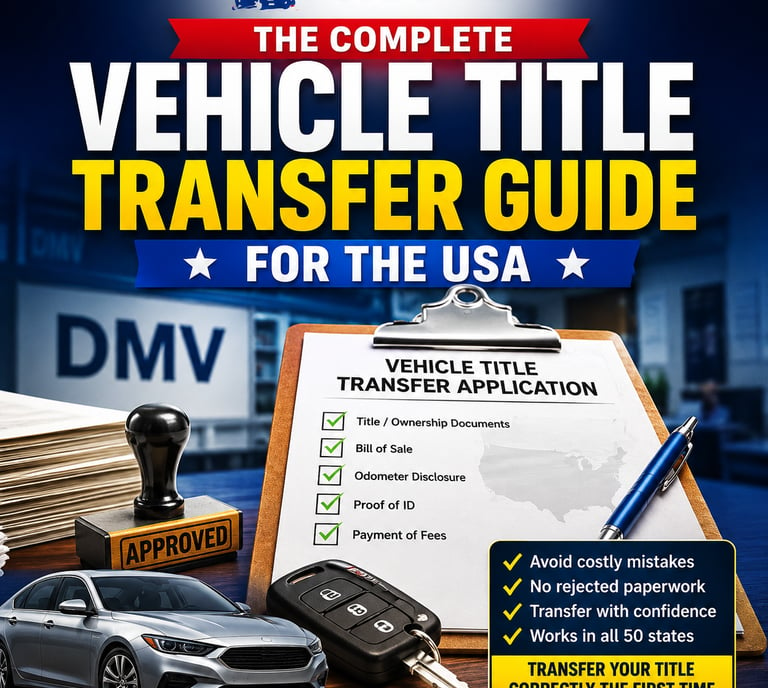
If you want DMV-style review checklists, green-file preparation guides, and scenario-based packet layouts that mirror how clerks actually work, the complete eBook shows you exactly how to submit like a professional.
👉 Make it easy to approve, and approval follows.https://transfercartitleusa.com/the-complete-guide
Help
Quick tips to avoid DMV delays
Contact
infoebookusa@aol.com
© 2026. All rights reserved.