How to Protect Your Car Title Long-Term (So Your Next Transfer Is Fast and Problem-Free)
Protect your car title from damage, loss, and costly mistakes that can delay future transfers. Learn smart long-term strategies for storing documents, tracking liens, verifying ownership records, and keeping DMV paperwork problem-free.
Dr. David Choi - Customer Experience & Content Strategist
4/30/20263 min read
How to Protect Your Car Title Long-Term (So Your Next Transfer Is Fast and Problem-Free)
Most title problems don’t start at the DMV.
They start years earlier, when a clean title is lost, damaged, altered, or stored badly—and only discovered when it’s time to sell, refinance, gift, or inherit the vehicle.
This guide explains how to protect your car title long-term, where to store it, what never to do with it, and how to future-proof your next title transfer so it’s fast instead of painful.
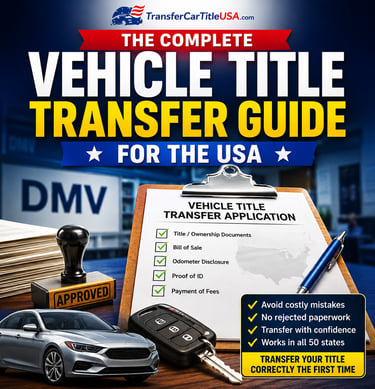
👉 If you want to transfer your car title the right way, the first time, the full eBook gives you everything you need—without confusion, delays, or costly mistakes.
https://transfercartitleusa.com/the-complete-guide
The Hard Truth About Titles
A car title is more fragile than people think—and more important than they realize.
A damaged or missing title can:
Delay sales for weeks
Force duplicate title requests
Trigger VIN inspections
Require bonded titles
Kill private-party deals
Prevention is far easier than repair.
Rule #1 — Never Store the Title in the Vehicle
This is the most common and costly mistake.
If the car is:
Stolen
Broken into
Towed
Impounded
…the title may be lost or misused.
A title inside the car is an open invitation for fraud.
Rule #2 — Do Not Fold, Laminate, or Write on the Title
Titles are legal documents—not keepsakes.
Never:
Fold repeatedly
Laminate
Write notes
Highlight
Staple
Paperclip long-term
Add sticky notes
Many DMVs reject titles that are:
Creased excessively
Altered
Laminated (yes, really)
Rule #3 — Store the Title Like a Legal Document
Best storage options:
Fireproof home safe
Lockbox
Document folder with other legal records
Avoid:
Glove compartments
Desk drawers
Random folders
Old envelopes
Wallets
Treat the title like a deed—not a receipt.
Rule #4 — Keep Digital Copies (But Know Their Limits)
You should keep:
High-quality scans
Clear photos (front and back)
These help with:
Duplicate title requests
Lost-title recovery
VIN verification
DMV follow-ups
But remember:
Digital copies never replace the original title.
They support recovery—they don’t transfer ownership.
Rule #5 — Update Your Address With the DMV Immediately
Titles are mailed to:
The address on DMV record
Not always the application address
If you move and don’t update your address:
Your title may be mailed elsewhere
Returned titles can be delayed or destroyed
Replacement requests take time and money
Always update your address before a transfer.
Rule #6 — Understand Electronic Title States
If your state uses electronic titles:
You may not have a paper title
The DMV or lienholder holds it digitally
Know:
How to request a paper title
How long issuance takes
Whether fees apply
Waiting until a sale to learn this causes delays.
Rule #7 — Request a Paper Title Before You Need It
Even in electronic title states, request a paper title if:
You plan to sell privately
You plan to move out of state
You expect inheritance or gifting
You want physical proof of ownership
Advance preparation saves weeks later.
Rule #8 — Protect the Title During Life Events
Major life events increase title risk:
Marriage or divorce
Name changes
Moves across state lines
Death of a co-owner
Business formation or dissolution
Each event can complicate future transfers if the title isn’t updated promptly.
Titles don’t “self-correct.”
Rule #9 — Never Pre-Sign a Title “Just in Case”
Some people pre-sign titles to “save time.”
This is extremely risky.
Why:
Dates may expire
Ownership situations may change
Fraud risk increases
Many states reject undated or stale signatures
Always sign at the moment of transfer.
Rule #10 — Keep Supporting Documents With the Title (But Separate)
Keep copies of:
Lien release
Bill of sale (past)
Probate or affidavit documents (if applicable)
POA (if ever used)
But:
Do not attach them permanently
Do not staple them to the title
Store together—but not physically attached.
How Title Damage Creates Chain Problems
A damaged or lost title often leads to:
Duplicate title requests
Processing delays
Extra fees
VIN inspections
Bonded title requirements
Buyer distrust
One careless moment can echo for years.
Quick Title Protection Checklist
Do this once and you’re set:
☐ Store title securely
☐ Keep digital copies
☐ Update address with DMV
☐ Avoid writing or folding
☐ Know if your state uses e-titles
☐ Request paper title early if needed
Ten minutes now can save months later.
The One Rule That Prevents Future Nightmares
If your title stays clean, readable, current, and secure, every future transfer becomes routine.
Most DMV nightmares are preventable.
Final Takeaway
The fastest title transfer is the one you prepared for years in advance. Protecting your title properly turns future sales, gifts, and inheritances into simple paperwork—not stressful recovery projects.
If you want:
state-specific title storage rules
electronic vs paper title planning
life-event title update checklists
future-proof transfer strategies
…the complete eBook shows you how to keep your ownership records clean for life.
👉 Protect the title today—or pay for it later.https://transfercartitleusa.com/the-complete-guide
Help
Quick tips to avoid DMV delays
Contact
infoebookusa@aol.com
© 2026. All rights reserved.