
DMV Title Transfer Explained: Avoid Common Traps
Stop walking blindly into a DMV trap. Our comprehensive guide on vehicle title transfer explained provides essential tips to navigate the process smoothly. Don't let clerks reject your paperwork or incur fines. Learn how to dominate the bureaucracy and get your title fast! UPDATE 08/28/2026
Dr. James R. Sterling - Founder & Lead Documentation Specialist
12/24/20256 min read
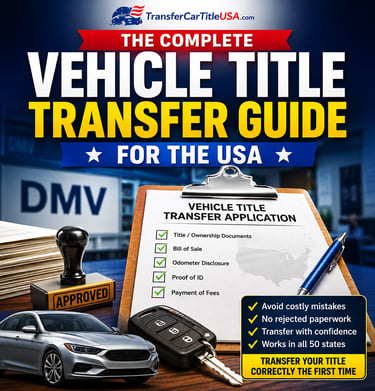
👉 If you want to transfer your car title the right way, the first time, the full eBook gives you everything you need—without confusion, delays, or costly mistakes.
Vehicle Title Transfer Explained: Everything You Must Know Before Going to the DMV (update 08/28/2026)
Transferring a vehicle title in the United States looks deceptively simple. You sign a document, hand it over, and assume the rest will take care of itself. In reality, this assumption is the reason so many people leave the DMV frustrated, delayed, or forced to start over.
This article explains everything you must know before going to the DMV—how title transfers really work, what the DMV actually checks, and how to avoid the mistakes that cause rejections, delays, and legal exposure. If you read this once before you sign anything, you dramatically increase your chances of first-time approval.
👉 If you want to transfer your car title the right way, the first time, the full eBook gives you everything you need—without confusion, delays, or costly mistakes.
https://transfercartitleusa.com/the-complete-guide
🧭 Executive Summary: The Universal 4-Step Title Transfer Framework
Transferring a vehicle title can seem complex, but it fundamentally follows a standardized four-phase lifecycle. Regardless of your state, missing a single signature, failing to release liability, or miscalculating local sales tax can lead to immediate rejection at the DMV counter.
By understanding this structural process, preparing accurate documentation, and utilizing available digital channels, you can minimize processing times from weeks to minutes.
🏛️ Section 1: Anatomy of a Vehicle Title Certificate
A Certificate of Title is not a mere receipt; it is a state-issued legal security document printed on specialized paper with security threads, intaglio printing, and watermarks to prevent forgery. Understanding its visual anatomy is critical before making any ink markings.
Key Visual and Legal Quadrants
The Primary Header (Ownership Block): Contains the official name and physical address of the current registered owner(s).
The Vehicle Identification Profile: Displays the unique 17-digit VIN, make, model, year, body type, and empty weight.
The Lienholder/Legal Owner Section: Identifies whether a bank, financial institution, or private party holds a security interest in the vehicle.
The Assignment of Title (Transfer Block): Found either on the reverse side or bottom third of the front page. This contains fields for the seller's signature, buyer's information, odometer disclosures, and purchase price.
Title Signatures: Conjunction Logic
When multiple names are printed on the front of a title, the grammatical conjunction between them determines the legal signing requirements:
Conjunction Between NamesLegal MeaningAction Required for Title Transfer"OR"Joint tenancy with right of survivorship.Only one owner needs to sign the title to release ownership."AND"Tenancy in common.Both owners must sign the title to legally transfer the vehicle."AND/OR"Varies by state (e.g., California).Usually, either party can sign, but best practice dictates obtaining both signatures.
🗺️ Section 2: Complete Blueprint by State (Processing Timelines & Cost Matrices)
The administrative procedures, fees, and processing times vary significantly across state jurisdictions. Below is an exhaustive breakdown of the requirements for four of the largest US automotive markets: California, Texas, Florida, and New York.
☀️ California DMV Requirement Protocol
Required Forms: Form REG 227 (if title is lost) or the original Certificate of Title; Form REG 343 (Application for Title or Registration).
Smog Certification Rule: The seller must provide a valid smog certification that is less than 90 days old, unless the vehicle is electric, hybrid, or less than 8 model years old.
Release of Liability: The seller must submit a Notice of Transfer and Release of Liability (Form REG 138) within 5 days of sale.
🤠 Texas DMV (TxDMV) Requirement Protocol
Required Forms: Form 130-U (Application for Texas Title and/or Registration); Original Title signed by both parties.
The 30-Day Rule: The buyer must apply for a new title within 30 calendar days of purchase to avoid monetary penalties.
Financial Protection: The seller should immediately file a Texas Motor Vehicle Transfer Notification to end liability for toll violations or crimes committed in the vehicle.
🐊 Florida DHSMV Requirement Protocol
Required Forms: Form HSMV 82040 (Application for Certificate of Title); Form HSMV 82050 (Notice of Sale).
VIN Verification: Out-of-state vehicles coming into Florida must undergo a physical VIN verification verified by a law enforcement officer or DMV inspector.
Tax Collection Structure: Handled primarily at the county level through County Tax Collectors, providing fast over-the-counter physical document processing.
🍎 New York DMV (NYSDMV) Requirement Protocol
Required Forms: Form MV-82 (Vehicle Registration/Title Application); Form DTF-802 (Statement of Transaction for Sales Tax).
Sales Tax Enforcement: NY State enforces strict audits on purchase prices via the Department of Taxation and Finance to prevent tax underreporting.
Proof of Insurance: NY requires electronic insurance notification on file before any registration or transfer can be approved.
Comprehensive Multi-State Comparison Table
🛠️ Section 3: Step-by-Step Title Transfer Playbook
Phase 1: The Transaction (Seller Actions)
Locate and Authenticate the Title: Ensure the document is the latest issued version and completely free of defacement.
Release the Lien: If a bank loan existed, ensure the lienholder section is signed off or a formal notarized Lien Release letter is attached.
Record Odometer Mileage: Write the exact current dashboard mileage in the disclosure section without rounding numbers.
Execute Signatures: Sign your legal name precisely as it appears on the front of the document.
File Liability Release: Submit the state-specific liability waiver within 24 to 72 hours to prevent downstream legal issues.
Phase 2: The Acquisition (Buyer Actions)
Verify VIN and Identity: Cross-reference the 17-digit VIN on the car’s dashboard plaque with the title certificate. Verify the seller’s photo ID matches the title name.
Execute Buyer Signatures: Fill out your legal name, physical address, and sign the buyer's block.
Secure a Formal Bill of Sale: Ensure both parties execute a comprehensive Bill of Sale detailing purchase price, date, and vehicle specs.
Acquire State Inspections: If required by your state, take the car to a licensed station for a smog check or VIN verification.
Submit to the DMV: Bring all paperwork, proof of active auto insurance, your driver's license, and payment for taxes/fees to your local DMV office.
⚠️ Section 4: Critical Pitfalls & Mitigation Strategies
Avoid these common, high-friction errors that routinely cause document rejections:
The White-Out Disaster: Never use white-out or corrective tape on a title certificate. Altered documents are immediately voided by state agencies. If an error occurs, you must file a formal Affidavit of Correction or apply for a duplicate title.
Odometer Discrepancy Lockout: Entering an incorrect mileage figure triggers an immediate title fraud alert. If a mistake is made, a notarized odometer correction statement must be signed by both buyer and seller.
The "Skipped Title" Trap: Purchasing a vehicle from someone whose name is not on the front of the title is illegal ("title skipping"). The seller must title the car in their name first before legally selling it to you.
Unreleased Bank Liens: Buying a car with an active lien means the lender legally owns the vehicle. Ensure the title features an official bank stamp or a separate notarized lien release document from the lender.
❓ Frequently Asked Questions (FAQ)
1. Can you transfer a vehicle title online?
Yes, many states have introduced digital portals. California provides the Virtual DMV assistant, Texas features eTitle updates, and New York allows specific digital processing options. However, out-of-state transfers and complex lien releases typically require physical mail-in or in-person verification.
2. What should I do if the original title is lost or destroyed?
The current registered owner must apply for a duplicate title before any transfer of ownership can occur. This requires filling out a state-specific form (such as CA Form REG 227 or TX Form VTR-34) and paying a duplicate title fee.
3. How are taxes calculated during a family transfer?
Most states provide special tax exemptions or flat nominal fees for vehicle transfers between immediate family members (parents, children, spouses). This requires submitting an additional family affidavit form alongside the title application to waive standard sales tax.
Going to the DMV unprepared is not a time-saver—it’s a risk. Vehicle title transfers reward caution, clarity, and precision. When you understand how the process works before you arrive, you avoid delays, extra fees, and legal headaches.
-------------------------------------------------------------------------------------------------------------------------------------------------------------
If you want the full step-by-step process, real-world scenarios, and a DMV-proof checklist that walks you through every situation—from liens to inheritance—the complete guide puts everything in one place.
👉 Before you go to the DMV, make sure you’re transferring your vehicle title the right way. The difference is preparation.https://transfercartitleusa.com/the-complete-guide


Help
Quick tips to avoid DMV delays
Contact
infoebookusa@aol.com
© 2026. All rights reserved.