
State-by-State Differences That Matter in Title Transfers (Why “It Worked for Them” Can Cost You Weeks)
Title transfer rules vary dramatically by state, and copying someone else’s experience can lead to delays, rejected paperwork, and extra fees. Learn the key state-by-state differences that matter before starting your DMV process.
Dr. Marcus Thorne - Operations & Compliance Manager
5/31/20263 min read
State-by-State Differences That Matter in Title Transfers (Why “It Worked for Them” Can Cost You Weeks)
One of the most dangerous assumptions in DMV processes is this:
“My friend did this and it worked.”
Title transfer rules are not universal. Small state-level differences—often invisible until submission—are responsible for thousands of rejections every year.
This guide explains which state-by-state differences actually matter, where people get misled, and how to avoid applying the right rule in the wrong state.
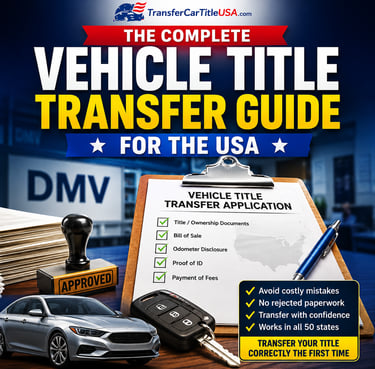
👉 If you want to transfer your car title the right way, the first time, the full eBook gives you everything you need—without confusion, delays, or costly mistakes.
https://transfercartitleusa.com/the-complete-guide
The Core Reality Most People Miss
DMV rules are state law, not federal guidance.
That means:
A process that works perfectly in one state
Can be rejected instantly in another
Advice without a state attached is incomplete advice.
Difference #1 — AND / OR Ownership Rules Vary by State
While AND/OR wording exists everywhere, its effects differ.
Examples:
Some states allow surviving OR owners to act alone
Others still require estate documentation
Some treat AND ownership more strictly after death
Never assume co-owner rules transfer across state lines.
Difference #2 — Small Estate Affidavit Thresholds Are Not the Same
Estate value limits vary wildly:
Some states: $25,000
Others: $100,000+
Some exclude vehicles
Some include vehicles
Some count only probate assets
Using the wrong threshold invalidates the affidavit.
Difference #3 — Transfer-on-Death (TOD) Titles Are Not Universal
TOD vehicle titles:
Are allowed in some states
Restricted in others
Completely unavailable in a few
Even where allowed:
Forms differ
Beneficiary limits differ
Revocation rules differ
A TOD that works in State A may not exist in State B.
Difference #4 — Electronic Title (E-Title) Systems
States differ on:
Whether paper titles exist at all
Who holds electronic titles (DMV vs lienholder)
How long paper issuance takes
Fees for paper copies
Moving states without requesting a paper title causes delays.
Difference #5 — Lien Release Recognition
Some states:
Accept electronic lien releases instantly
Require waiting periods
Demand paper confirmation
Others:
Don’t sync systems quickly
Require manual verification
Assuming instant lien clearance is a common mistake.
Difference #6 — Gift & Tax Exemptions
Gift transfers differ by state:
Some exempt family gifts fully
Others require affidavits
Some tax gifts anyway
Relationship definitions vary
A “tax-free gift” in one state may be taxable in another.
Difference #7 — VIN Inspection Triggers
VIN inspections are required:
Always in some states
Only for out-of-state titles in others
Only for certain vehicle ages elsewhere
Skipping an inspection because “it wasn’t required before” backfires.
Difference #8 — Power of Attorney Acceptance
POA rules vary by state:
Some require DMV-specific forms
Some require notarization
Some limit duration
Some reject generic POAs entirely
A valid POA in one state can be invalid in another.
Difference #9 — Business / LLC Title Transfers
States differ on:
Proof of business authority
Accepted titles for signers
Whether operating agreements are required
Whether dissolved entities can transfer
Assuming “owner = authority” fails in many states.
Difference #10 — Replacement & Bonded Title Rules
Bonded titles vary by:
Eligibility
Bond amounts
Bond duration
Approval standards
Some states rarely approve bonded titles at all.
Why Online Advice Is So Often Wrong
Online advice fails because:
It’s based on one state
State isn’t mentioned
Rules changed
The poster got lucky
The case was simpler than yours
Luck ≠ law.
How DMVs Enforce State Differences
Clerks:
Apply state statutes
Use state checklists
Ignore out-of-state anecdotes
Saying “another state allows this” has zero effect.
The Only Safe Way to Use Advice
Always ask:
Which state is this advice for?
Is my scenario identical?
Has the rule changed recently?
If any answer is unclear—verify with your state DMV.
The One Question That Prevents Cross-State Mistakes
Ask yourself:
Am I following my state’s rule—or someone else’s success story?
Only one matters.
Final Takeaway
Most DMV disasters don’t come from ignorance—they come from misapplied information. State-by-state differences aren’t details; they’re decision-makers.
If you want:
state-specific rule comparisons
transfer decision trees by state
common cross-state traps
moving-state checklists
…the complete eBook breaks down title transfer rules state by state.
👉 The right rule in the wrong state is still wrong.https://transfercartitleusa.com/the-complete-guide
Help
Quick tips to avoid DMV delays
Contact
infoebookusa@aol.com
© 2026. All rights reserved.