
The Final Rule: How to Make the DMV Work For You (Instead of Against You)
Learn the final rule for handling the DMV efficiently and with less stress. Discover how preparation, timing, communication, and the right strategy can help you avoid delays, solve problems faster, and make the DMV process work in your favor.
Dr. Marcus Thorne - Operations & Compliance Manager
9/16/20262 min read
The Final Rule: How to Make the DMV Work For You (Instead of Against You)
After everything in this series, there is one final rule that explains every approval, every rejection, every delay, and every “mysterious” DMV outcome.
It’s not written on any form.
But once you understand it, the DMV stops being unpredictable.
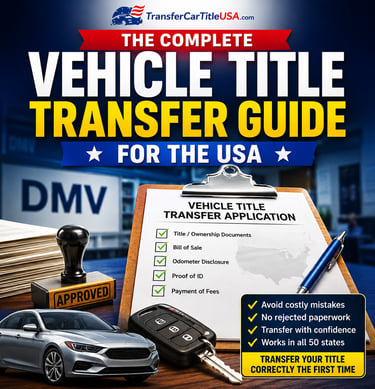
👉 If you want to transfer your car title the right way, the first time, the full eBook gives you everything you need—without confusion, delays, or costly mistakes.
https://transfercartitleusa.com/the-complete-guide
The Final Rule (Read This Twice)
The DMV doesn’t decide what is fair.
It decides what is defensible.
That’s it.
Everything else you’ve learned flows from this.
Why This Rule Explains Everything
A DMV clerk is not asking:
“Is this person right?”
“Does this make sense?”
“Is this fair?”
They are asking:
“Can this decision be defended if audited, questioned, or challenged?”
If yes → approved
If no → rejected, delayed, or escalated
What “Defensible” Means at the DMV
A defensible file has:
Clear authority
Clean ownership chain
Binary lien status (yes or no)
Matching VIN everywhere
Standard forms
No interpretation required
It does not require:
Explanations
Context
Good intentions
Logic
Fairness
Only documented certainty.
Why the DMV Feels Hostile (But Isn’t)
The DMV feels hostile because:
It cannot take risks
It cannot rely on judgment
It cannot assume intent
It cannot “work it out later”
Rejection is not punishment.
It’s risk avoidance.
The Moment Everything Changes
The moment things get easier is when you stop asking:
“How do I convince them?”
…and start asking:
“How do I remove every reason they could say no?”
That single shift changes outcomes.
How to Apply the Final Rule in Real Life
Before every DMV action, run this filter:
❌ Don’t ask:
“Will they understand?”
“Should this be okay?”
“Can I explain if they ask?”
“It worked for someone else”
✅ Ask instead:
“Is authority undeniable?”
“Is lien status binary?”
“Is the VIN identical everywhere?”
“Does this look routine?”
Routine = safe
Safe = approved
Why Slowing Down Makes You Faster
Rushing causes:
Combined steps
Early signatures
Missing authority
Panic fixes
Which lead to:
Rejections
Restarts
Weeks lost
Slowing down lets you:
Lock authority first
Resolve liens cleanly
Separate steps
Submit once
Slow upfront is fast overall.
The DMV Success Pattern (Always the Same)
Every successful case follows this pattern:
Authority established first
Liens resolved second
Identity verified third
Signatures executed last
Packet submitted clean
Issuance verified
Case closed and documented
Any deviation creates friction.
Why This Works in Every State
States differ in:
Forms
Thresholds
Timelines
They do not differ in:
Risk aversion
Audit exposure
Defensibility logic
This rule works everywhere because the incentive structure is the same.
The Ultimate DMV Litmus Test
Before you submit, ask:
If this file were reviewed by a different clerk tomorrow, would they reach the same conclusion without asking a question?
If yes → submit
If no → fix it first
The Hidden Advantage You Now Have
Most people:
React
Guess
Try
Explain
Escalate emotionally
You now:
Predict outcomes
Design submissions
Avoid ambiguity
Control the sequence
Close cases cleanly
That’s not luck.
That’s systems thinking.
One Last Warning (And It’s Important)
Never confuse:
“This should work”
with“This is defensible on paper.”
Only one matters.
Final Takeaway (The Sentence That Ends the Series)
The DMV is not difficult.
It is exact.
And exact systems reward people who design for them.
You don’t beat the DMV.
You align with it.
And when you do, everything gets boring.
Which is exactly the outcome you want.https://transfercartitleusa.com/the-complete-guide
Help
Quick tips to avoid DMV delays
Contact
infoebookusa@aol.com
© 2026. All rights reserved.